Lac des iles mine property
ADDING VALUE AT LOW COST
Exploration is central to the LDI operation. Based on their structurally-controlled sub-vertical orientation, unusually large thickness and atypical, selective enrichment in palladium relative to platinum, the LDI PGE deposits are truly one-of-a-kind. Sustained investment in near-mine exploration continues to deliver timely resource additions that derive from continually improving geological models.
Two major feeder structures are believed to have provided the critical pathways for palladium-rich magma to form the South LDI Complex, which hosts all past and present Mineral Resources on the property. Sulfides and palladium were concentrated within and directly adjacent to these structures. The LDI carrier magmas had strong geochemical similarities to the noritic magmas that produced the Merensky and UG2 reefs and the Platreef deposit in South Africa’s Bushveld platinum mining district. At LDI, the two principal ore zones are the semi-continuous Roby and Offset zones. In the central parts of both zones, palladium grades commonly average 4 g/t over true widths of 10–30 metres with maximum mining widths in the new SLS mining area reaching 100 metres. The highest-grade parts of the Roby and Offset zones exceed 10 g/t Pd over true widths of several metres. The Roby-Offset ore body remains open to the south and at depth. Satellite zones to the main deposit include the recently discovered Mystery Zone and the past-producing Twilight Zone.
UNDERGROUND EXPLORATION TARGETS
Current exploration programs are focused on adding resources directly adjacent to the underground reserves. Specific targets are shown on the longitudinal section, below.
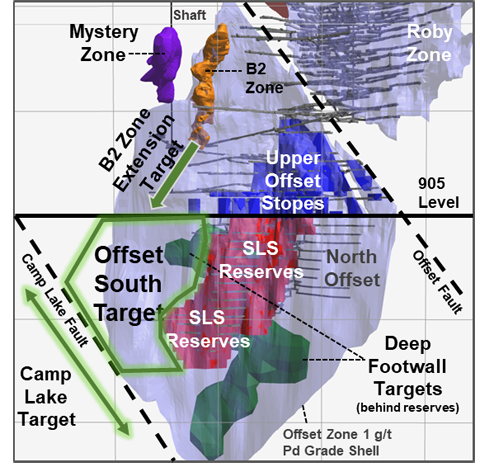
Longitudinal projection of the Offset Zone deposit, looking west, and showing the current priority underground exploration targets on the Property, including: (1) Offset South; (2) Camp Lake; (3) B2 Zone extension (3) Mystery Zone; (5) Deep footwall to Offset Zone.
SURFACE EXPLORATION TARGETS
High-priority, near-surface exploration opportunities include the Shorty-Baker and Creek Zone targets in the northeastern part of the complex and shown on the map, below.
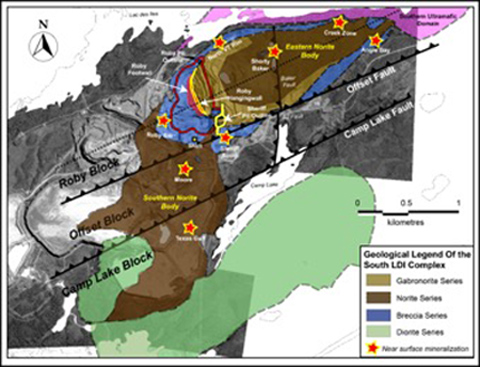
Plan view image of the Lac des Iles Mine Property showing the current, top-priority surface exploration target areas in the eastern part of the property (red stars) and recent drill hole collar locations (green circles) for the ongoing surface exploration program in the southern part of the property.
DEPOSIT MODEL
The revised LDI deposit model is described in detail in the October 2018 Technical Report. It involves three main stages that produced four main magmatic series as shown on the map, above.
Stage 1: Emplacement of barren, iron-rich magmas in the central and eastern part of the South LDI Complex, producing the Gabbronorite Series.
Stage 2: High-energy injection of water-rich noritic magmas transported palladium-rich copper-nickel sulfides into the South LDI Complex. The mineralized magmas separated during flow to form the magnesium-rich Norite Series and the aluminum-rich Breccia Series. Palladium mineralization occurs preferentially along the contacts between the Norite Series and the Breccia Series.
Stage 3: Intrusion of sodium- and potassium-rich magmas, producing the Diorite Series.